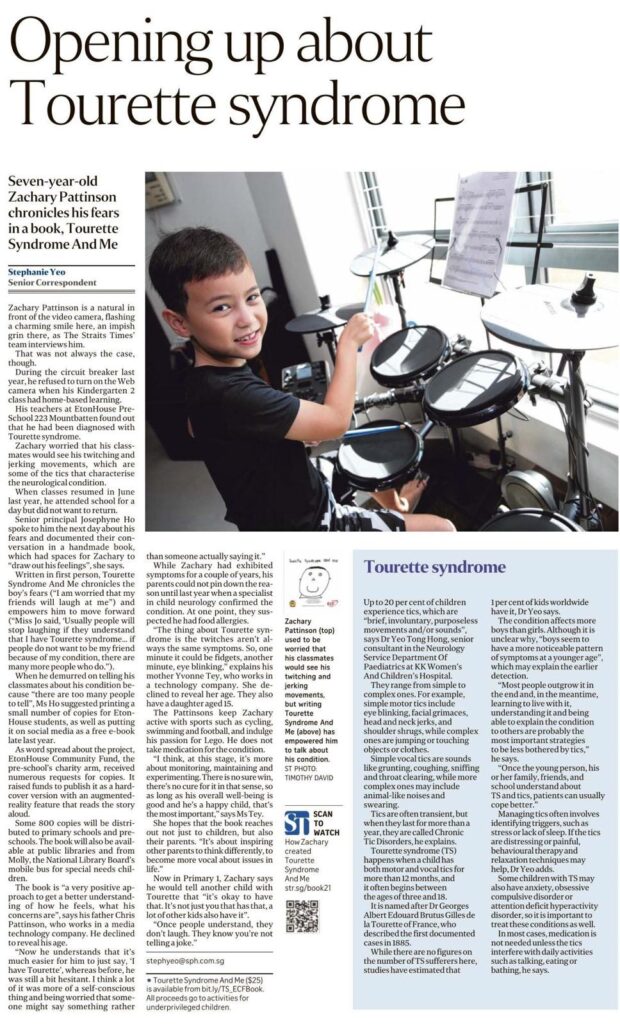
Seven-year-old Zachary Pattinson chronicles his fears in a book, Tourette Syndrome And Me
Zachary Pattinson is a natural in front of the video camera, flashing a charming smile here, an impish grin there, as The Straits Times’ team interviews him.
That was not always the case, though.
During the circuit breaker last year, he refused to turn on the Web. camera when his Kindergarten 2 class had home-based learning.
His teachers at Eton House Pre-School 223 Mountbatten found out that he had been diagnosed with Tourette syndrome.
Zachary worried that his classmates would see his twitching and jerking movements, which are some of the tics that characterise the neurological condition.
When classes resumed in June last year, he attended school for a day but did not want to return.
Senior principal Josephyne Ho spoke to him the next day about his fears and documented their conversation in a handmade book, which had spaces for Zachary to “draw out his feelings”, she says.
Written in first person, Tourette Syndrome And Me chronicles the boy’s fears (“I am worried that my friends will laugh at me”) and empowers him to move forward (“Miss Jo said, ‘Usually people will stop laughing if they understand that I have Tourette syndrome… if people do not want to be my friend because of my condition, there are many more people who do.”).
When he demurred on telling his classmates about his condition because “there are too many people to tell”, Ms Ho suggested printing a small number of copies for Eton-House students, as well as putting it on social media as a free e-book late last year.
As word spread about the project, EtonHouse Community Fund, the pre-school’s charity arm, received numerous requests for copies. It raised funds to publish it as a hardcover version with an augmented reality feature that reads the story aloud.
Some 800 copies will be distributed to primary schools and preschools. The book will also be available at public libraries and from Molly, the National Library Board’s mobile bus for special needs children.
The book is “a very positive approach to get a better understanding of how he feels, what his concerns are”, says his father Chris Pattinson, who works in a media technology company. He declined to reveal his age.
“Now he understands that it’s much easier for him to just say, ‘I have Tourette’, whereas before, he was still a bit hesitant. I think a lot of it was more of a self-conscious thing and being worried that someone might say something rather
than someone actually saying it.”
While Zachary had exhibited symptoms for a couple of years, his parents could not pin down the reason until last year when a specialist in child neurology confirmed the condition. At one point, they suspected he had food allergies.
“The thing about Tourette syndrome is the twitches aren’t always the same symptoms. So, one minute it could be fidgets, another minute, eye blinking,” explains his mother Yvonne Tey, who works in a technology company. She declined to reveal her age. They also have a daughter aged 15.
The Pattinsons keep Zachary active with sports such as cycling. swimming and football, and indulge his passion for Lego. He does not take medication for the condition.
“I think, at this stage, it’s more about monitoring, maintaining and experimenting. There is no sure win, there’s no cure for it in that sense, so as long as his overall well-being is good and he’s a happy child, that’s the most important,” says Ms Tey.
She hopes that the book reaches out not just to children, but also their parents. “It’s about inspiring other parents to think differently, to become more vocal about issues in life.”
Now in Primary 1, Zachary says he would tell another child with Tourette that “it’s okay to have that. It’s not just you that has that, a lot of other kids also have it”.
“Once people understand, they don’t laugh. They know you’re not telling a joke.”
Tourette Syndrome
Up to 20 per cent of children experience tics, which are “brief, involuntary, purposeless movements and/or sounds”, says Dr Yeo Tong Hong, Senior Consultant in the Neurology Service Department Of Paediatrics at KK Women’s And Children’s Hospital.
They range from simple to complex ones. For example, simple motor tics include eye blinking, facial grimaces, head and neck jerks, and shoulder shrugs, while complex ones are jumping or touching objects or clothes.
Simple vocal tics are sounds like grunting, coughing, sniffing and throat clearing, while more complex ones may include animal-like noises and swearing.
Tics are often transient, but when they last for more than at year, they are called Chronic Tic Disorders, he explains.
Tourette syndrome (TS) happens when a child has both motor and vocal tics for more than 12 months, and it often begins between the ages of three and 18.
It is named after Dr Georges Albert Edouard Brutus Gilles de la Tourette of France, who described the first documented cases in 1885.
While there are no figures on the number of TS sufferers here, studies have estimated that
1 per cent of kids worldwide have it, Dr Yeo says.
The condition affects more boys than girls. Although it is unclear why, “boys seem to have a more noticeable pattern of symptoms at a younger age”, which may explain the earlier detection.
“Most people outgrow it in the end and, in the meantime, learning to live with it, understanding it and being able to explain the condition to others are probably the most important strategies to be less bothered by tics,” he says.
“Once the young person, his or her family, friends, and school understand about TS and tics, patients can usually cope better.”
Managing tics often involves identifying triggers, such as stress or lack of sleep. If the tics are distressing or painful, behavioural therapy and relaxation techniques may help, Dr Yeo adds.
Some children with TS may also have anxiety, obsessive compulsive disorder or attention deficit hyperactivity disorder, so it is important to treat these conditions as well.
In most cases, medication is not needed unless the tics interfere with daily activities such as talking, eating or bathing, he says.