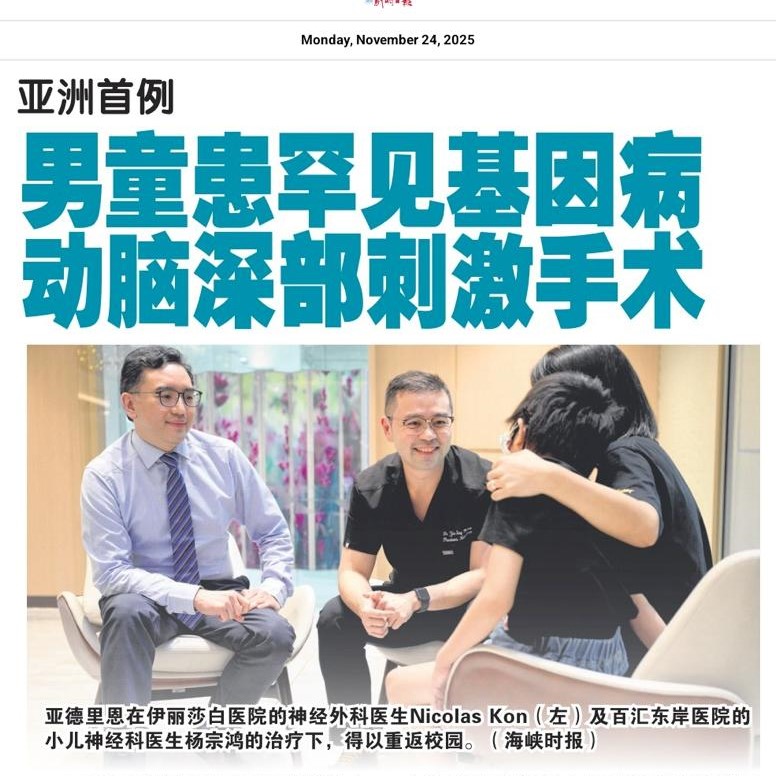
Adrian was able to return to school thanks to treatment from Neurosurgeon Dr Nicolas Kon (left) at Queen Elizabeth Hospital and Pediatric Neurologist Dr Yeo Tong Hong at Parkway East Hospital. (The Straits Times)
An 11-year-old boy was diagnosed with a GNAO1 gene mutation after genetic testing. He eventually recovered through deep brain stimulation surgery, becoming the first child in Asia to undergo this surgery.
The GNAO1 gene is responsible for the signal “switch” between neurons in the brain. Mutations in this gene can cause uncontrollable twitching, muscle stiffness, and developmental delays. Rare GNAO1 gene mutations can only be diagnosed through genetic testing, and fewer than 500 people worldwide are known to have such rare mutations.
According to The Straits Times, Adrian’s developmental delays became apparent when he was nine months old. He was unable to sit up independently, could not crawl, did not babble, and lacked communication skills. Doctors diagnosed him with cerebral palsy and treated him accordingly.
In June of this year, Adrian’s condition deteriorated rapidly after contracting influenza A. He not only had a high fever, but his legs also began to tremble violently. Even with medication, he remained weak and powerless, his legs continued to shake uncontrollably and repeatedly, and his body became so stiff that he could not even be placed in a wheelchair.
A relative working at KK Women’s and Children’s Hospital suggested she take her child to see Dr. Lim Chih-Yuan, a pediatric neurologist there. Subsequently, Adrian underwent genetic testing and was diagnosed with the GNAO1 gene mutation in July. After the diagnosis, he was referred to another doctor.
Dr Yeo Tong Hong, a Pediatric Neurologist at Parkway East Hospital, believes that deep brain stimulation (DBS) is Adrian’s only chance. “I originally planned to advise the parents to take him to the UK or the US for the surgery, but then I discovered that Singapore has only one specialist, Dr. Nicolas Kon, who can perform this surgery on children.”
Deep brain stimulation (DBS) is an advanced treatment that involves implanting two extremely thin electrodes into specific areas of the brain. These electrodes are connected subcutaneously to a battery device, typically placed in the chest or abdomen. This pulse generator delivers a weak electrical current that helps modulate brain activity and reduce symptoms of muscle contractions.
Adrian was subsequently referred to Elizabeth Hospital, where the aforementioned doctor worked, and underwent a four-hour surgery on July 19, becoming the first GNAO1 patient in Asia to undergo this surgery.
After four months of postoperative rehabilitation and multiple physical therapy sessions, Adrian has successfully returned to school. He currently uses a walking aid and his involuntary movements have significantly decreased.
The mother said gratefully, “We are very grateful for the doctors’ efforts; they saved Adrian from a critical situation. I hope to share his story so that more parents realize that for illnesses of unknown cause, genetic testing should be conducted as early as possible to find the right treatment.”